Harnessing Alkaline-earth Metal Reactivity: Mechanistic Insights into Alkene and Alkyne Functionalization via Organomagnesium(II) and Organobarium(II) Catalysis
Abstract
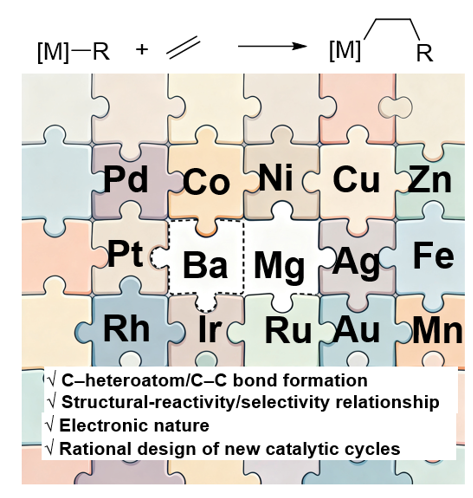
Main-group catalysis is rapidly reshaping the landscape of modern catalysis, yet a detailed understanding of how s-block metals orchestrate complex bond transformations remains limited. Here, we present a comprehensive in silico exploration of alkene and alkyne functionalization catalyzed by organomagnesium(II) and organobarium(II) complexes. Through density functional theory (DFT) and orbital interaction analyses, we reveal how metal identity, migrating group, ligand environment, additives, and substrate structure collectively govern the thermodynamics, kinetics, and regioselectivity of s-block metal–element bond migratory insertions. Two distinct reactivity regimes emerge: Mg(II) engages in orbital coupling and back-donation, whereas Ba(II) behaves as a nearly pure nucleophilic center with minimal metal–carbon coupling. For heavier alkaline-earth metals, dimerization acts as a reactivity bottleneck that can be alleviated through crown ether–type or multidentate ligands. Remarkably, Mg(II) and Ba(II) exhibit complementary chemoselectivity: Mg(II) enables C–heteroatom coupling, whereas Ba(II) enables C–C bond formation. Guided by these mechanistic insights, we propose seven catalytic blueprints encompassing Mg(II)-catalyzed anti-Markovnikov alkoxylation, alkylthiolation, enol ester formation, and epoxide polymerization, as well as Ba(II)-catalyzed cross coupling, arylsilylation, and cascade [2+1] cyclopropanol synthesis. Together, these results establish a unified conceptual framework for s-block reactivity and offer new principles for designing sustainable catalysis using earth-abundant, non-redox metals.

Yumiao Ma
Computational Chemistry to the Heaven.